
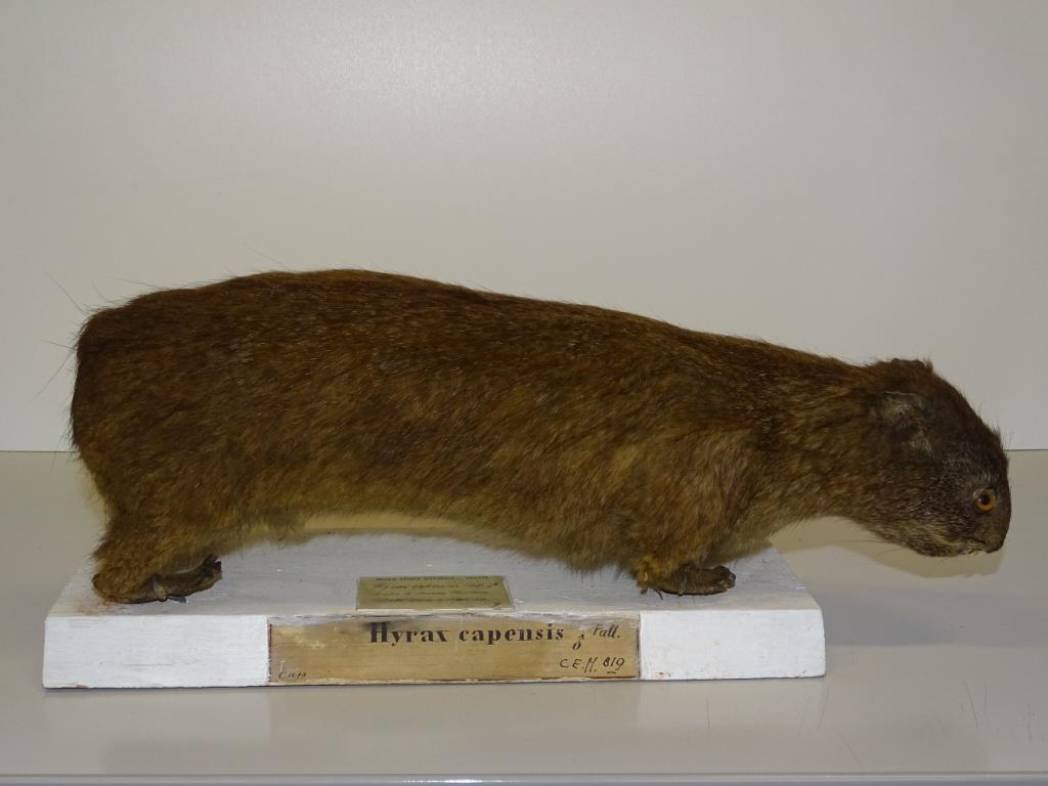
Procavia capensis Pallas, 1766
From the Reise der österreichischen Fregatte Novara [...] Zoologischer Theil, J.Zelebor, "Säugetiere":
"By examining the skulls and skins of the rock hyrax specimens I brought with me from the mountains near Constantia and the specimens in the museum, I came to the conclusion that Hyrax habessinicus Ehrenb. significantly more than H. syriacus Schreb. is different from H. capensis and is the same. If one does not want to group them all together at random, H. syriacus equally deserves to be recognised as a species. H. habessinicus differs from H. capensis in that it has a significantly longer, narrower and lower head, a longer snout and a greater distance between the eyes and ears. The skull in particular differs in that it has pointed, wedge-shaped premaxillae that reach almost to the anterior corners of the eyes, longer nasal bones, longer, narrower and more convex frontal bones (in capicus they are almost cone-shaped) and the transverse connection of the forehead that is angled backwards - and narrower parietal bones and parietal crest. If one did not want to consider these significant differences as species characteristics, one would have to combine all the species described so far as local forms with H. capensis. As Kolbe and some other travellers report, the Cafri are said to catch rock hyrax with their hands. An old Cafri, whom I used as a hunter during our stay at the Halfwayhouse (Mr Rathfelder's farm) near Constantia, said of this object: "Yes, we catch the Embille with our hands, but only when it is taken from its burrow in the open air, placed by dogs trained for this purpose, or when the bight (the den) can be opened." In this way, three to five specimens are often caught on clear days and especially on moonlit days. Concerning the Hyraceum, called by the Dutch settlers "Dassenpiss" or Dachsharn, my hunter reported to me that he found the same in large quantities, from the area around Table Mountain and from other places, because in recent times most of his fellow tribesmen and to some extent also the Dutch have given up believing in the special healing power of this substance and now this once so popular remedy lies unused in large quantities near the burrows of the rock hyrax.
Collection site: Cape of Good Hope. Two old and three young specimens. (W. and B.)" (p.35-36)


© 2026 Global Sea Routes - All Rights Reserved