
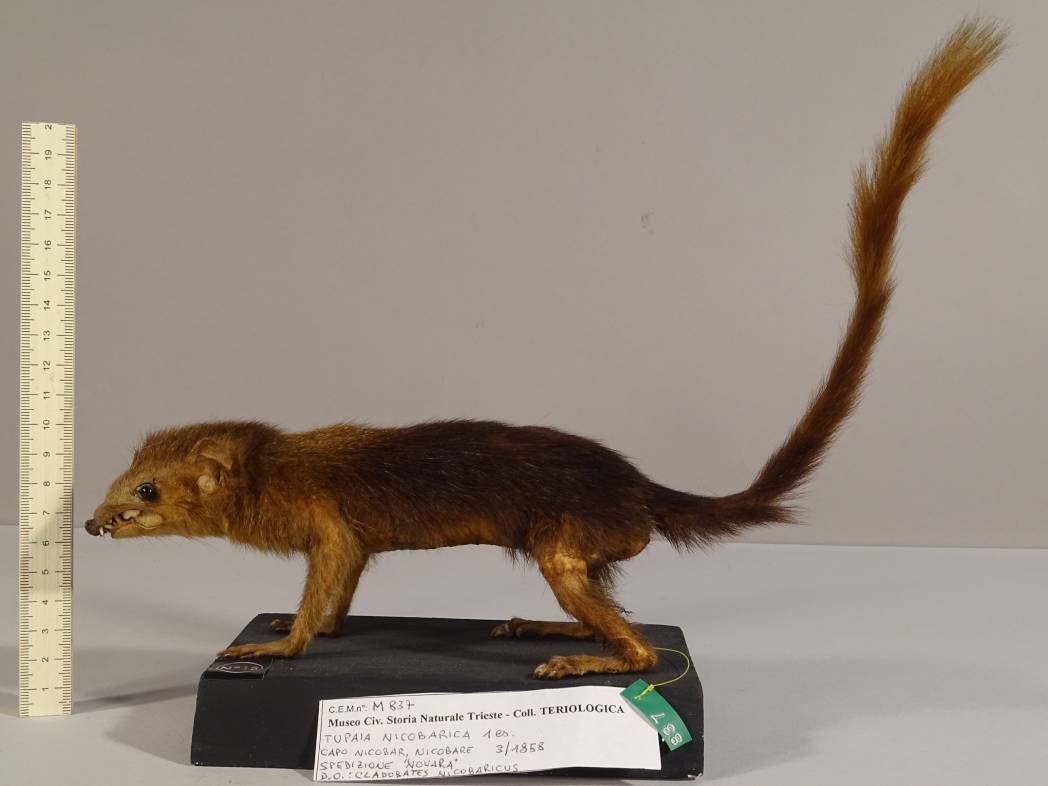
Tupaia nicobarica (Zelebor, 1869)
From the Reise der österreichischen Fregatte Novara [...] Zoologischer Theil, J.Zelebor, "Säugetiere":
"In shape and size, this species is very similar to Cladobates ferrugineus, from which it can be immediately distinguished by its different colouring and its much longer, shorter and more cylindrical tail. Dark brown iris. The dark rust-brown colour of the top of the head starts with a pointed wedge-shaped spot on the back of the snout and is divided into a wide band on each side of the occiput that runs along the neck and the front of the back, while an ochre-coloured band originating in the occiput extends over the neck and the middle of the front of the back. The entire back is shiny black, extending to the base of the tail. The muzzle, the sides of the head, the entire ventral side of the animal, as well as the forelimbs are ochre in colour, with the middle of the belly and the inner side of the forelimbs appearing lighter; the hind limbs are dark brown both on the outside and on the back. The tail is dark russet brown with purplish highlights, blacker at the base. The claws of the toes are slightly smaller than those of the feet, which immediately distinguishes this species from Cladobates tana. Cladobates ferrugineus is also closest to the earlier species in the formation of the teeth and skull. However, Cladobates nicobaricus differs slightly: 1. in the simpler, almost cuspless structure of the upper penultimate molar and the lower last molar; 2. from the small development of the fossa outside the zygomatic process of the upper jaw and 3. from the much more developed angle and ascending part of the lower jaw. This shrew, which is found in all the larger Nicobar Islands, but most frequently in the Grand Nicobar, cries ‘Danh-Danh’ very often and with a long, drawling accent when disturbed or chased. One specimen in alcohol, one skeleton and four stuffed specimens". (pp.16-17-18)
Reise der österreichischen Fregatte Novara um die Erde: in den Jahren 1857, 1858, 1859 unter den Befehlen des Commodore B. von Wüllerstorf-Urbair. Zoologischer Theil, 1. Band: Wirbelthiere, Wien, Aus der Kaiserlich-Königlichen Hof- und Staatsdruckerei, 1869, J.Zelebor, "Säugetiere", pp. 16-17-18


© 2026 Global Sea Routes - All Rights Reserved