
From the Reise der österreichischen Fregatte Novara [...] Zoologischer Theil, A. Pelzeln, "Vögel":
"A total of three males, five females, one juvenile bird and one sexless older bird were prepared on skins and skeletons; one egg was laid at the nesting site among the young birds and other explants were preserved thanks to the kind intervention of Dr. Scherzer. Some birds listed here are preserved for anatomical purposes.
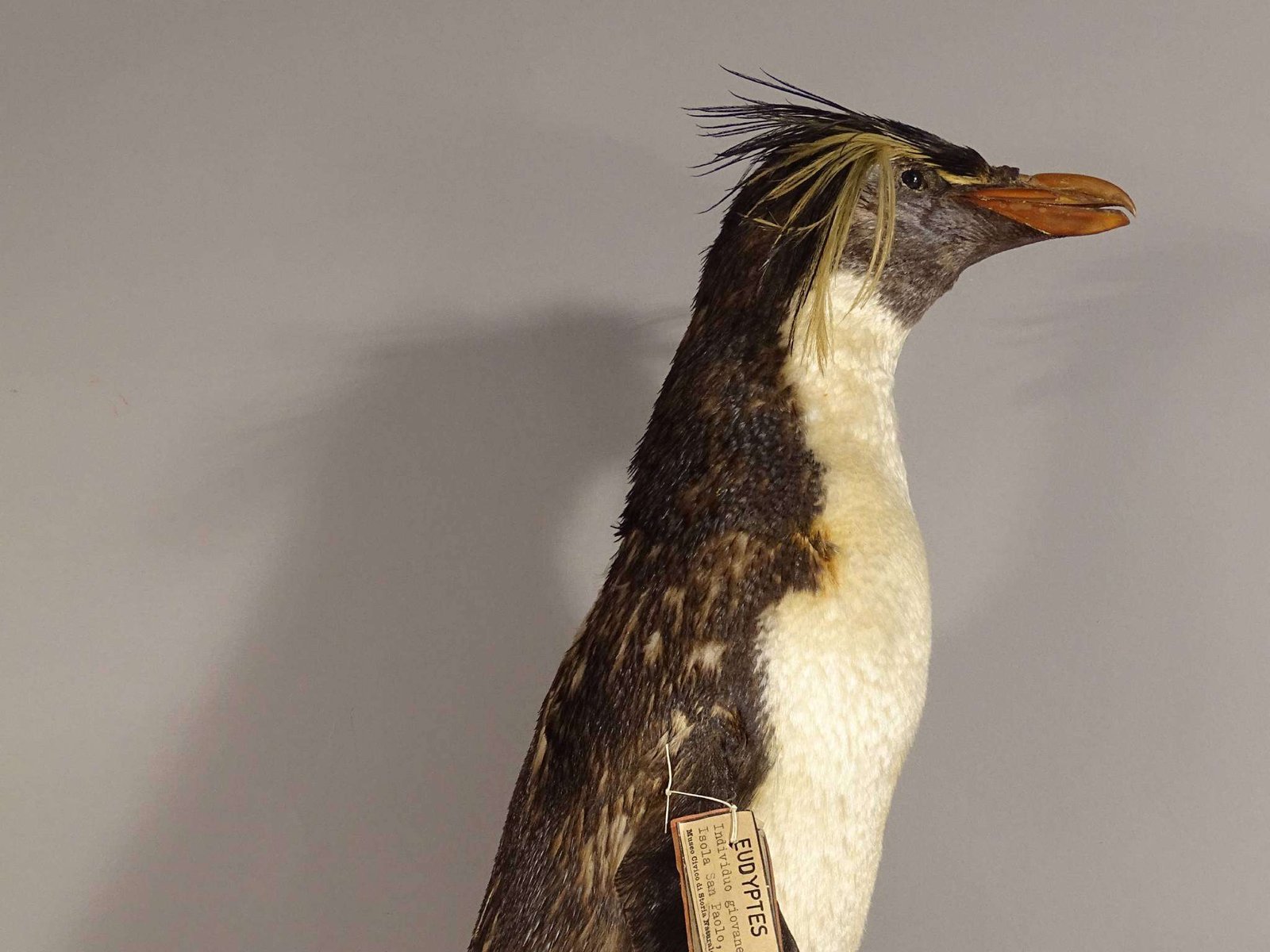
The very young bird is covered with brown down on the upper part and throat and white down on the rest of the underside. The beak is dark with a reddish tip. A slightly older male shows only remnants of plumage on the head and neck, but the feathers are still incompletely developed in places, especially on the neck, so that the skin between them is visible. There is still no trace of the extended head feathers, the beak is dark with a reddish tip. On a slightly more advanced male, feather formation is complete, the down has disappeared, the yellow stripe on the head and tufts of feathers begin to be visible. The beak is red. To make the gradual development evident, the individuals described here are shown in Table V, together with an adult specimen.
[…]
Eudptes Chrysocome was described by Forster (Descript. Anim. 99 and 348) from a specimen in southern New Holland. Gould (Birds of Australia) states that this species is sometimes found on the coast of Van Diemensland and the south coast of Australia, but its great habitats are the islands of Amsterdam, St. Paul and Tristan d'Accunha." (p.140)


© 2026 Global Sea Routes - All Rights Reserved